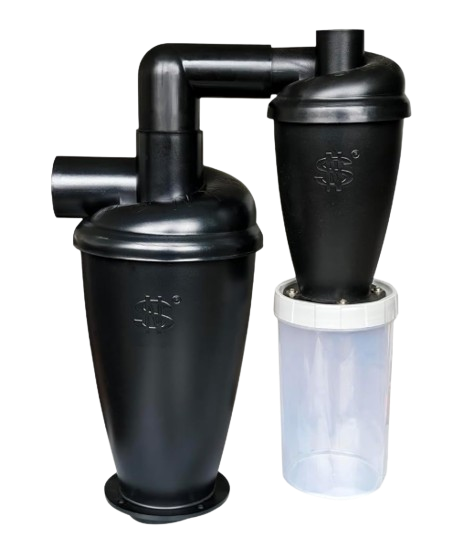
The Cyclone Dust Separator Review — What Can the 6″ Cyclone Separator Do for Your Shop?
Disclosure: Dust Collector Reviews is a participant in the Amazon Associates Program, an affiliate advertising program designed to provide a means for sites to earn advertising fees by linking to Amazon.
Introduction
The problem when you’re reading through the various cyclone dust separator reviews out there is that they don’t give you the full picture. Most won’t show you the math behind particle breakdown in your shop’s air after installing one. When you connect a cyclone separator to a vacuum source, a cyclonic suction force is created that collects large dust particles and chips efficiently, while also capturing many smaller particles. Consequently, this acts as a pre-filter that prevents the majority of debris from ever reaching your dust collector’s filter.
Related: Ready to upgrade? See our Oneida Dust Deputy compact cyclone option.
Why Use a Cyclone Dust Separator?
Safety First
The number one reason for using a cyclone dust separator is safety. It cleans the air, giving you a safer and cleaner breathing environment during woodworking. Additionally, it alleviates strain on your filters, preventing or severely delaying clogs that can cause electrical shorts and blowouts — the kind that could spark a fire in your shop.
Save Money on Filters
Furthermore, another major reason is cost savings. Since the cyclone separates dust and chips before they hit your filter, you simply empty the container regularly. Filter replacement costs drop drastically as a result.
Improved Shop Efficiency
Perhaps the best reason is overall environment control. A cleaner shop is a more efficient workspace where you can focus on your projects rather than dealing with dust cleanup.
Pro Tip: Pair this with a quality dust collector like the Grizzly G0440 for maximum efficiency.
Particle Size Filtration Efficiency
| Particle Size | Filtration Rate |
|---|---|
| < 10 microns | 5–10% |
| 20–50 microns | 60–70% |
| 100–200 microns | >95% |
| 200–300 microns | >99% |
Note: 100 microns is approximately 0.004 inches — about the width of a human hair.
Physical Specifications
| Specification | Measurement |
|---|---|
| Overall Length | 41″ |
| Diameter | 18″ |
| Cylinder Body Length | 15″ |
| Cone Length | 24″ |
| Inner Tube Length | 17″ |
| Top Inlet Diameter | 6″ |
| Top Outlet Diameter | 7″ |
| Bottom Outlet Diameter | 6″ |
| Mounting Flange Diameter | 8½″ |
| Flange Holes | 8 (¼″ each) |
| Flange Material | 1/8″ Steel |
| Cyclone Material | G90, 24ga. Galvanized |
| Weight | 25 lbs |
Uses and Advantages
Your cyclone separator can mount to a wide variety of vessels as long as they’re sealed. Common options include:
- Galvanized trash cans
- Fiber barrels
- Wooden boxes
- Professional disposal units
How to test for a proper seal: Turn on your dust collector and gently lift the cyclone separator. If your collection vessel comes up with it, you have a good seal.
Mounting tip: Be careful that your setup isn’t too top-heavy. If needed, secure your cyclone separator to the wall or ceiling to prevent tipping.
Pro Tip: This works with most dust collectors including the JET DC-650 and Laguna Tools MDC0560.
Final Verdict
The cyclone dust separator earns 4.5 out of 5 stars. Whether you’re running a home woodworking shop or using industrial sanders and planers that kick out large amounts of dust, you’ll benefit greatly from a cyclone separator. Even after four to five hours of continuous sanding, planing, or wood cutting, the amount of debris your cyclone captures before it reaches your main filter is impressive. It protects your health, extends equipment life, and saves money on filters.
Quick Comparison
| Feature | 6″ Cyclone Separator | Oneida Dust Deputy | Grizzly G0440 | Laguna D|Flux I |
|---|---|---|---|---|
| Type | Add-on separator | Compact cyclone | Integrated cyclone | Integrated cyclone |
| Dust Capture | 95%+ (100μ+) | 99% | 99.9% | 95% |
| Inlet Size | 6″ | 2.5″ | 6″ | 4″ |
| Collection | Your container | 2 x 5 gal buckets | 35 gal drum | 20 gal drum |
| Requires | Dust collector | Shop vacuum | Dust collector | Dust collector |
| Setup | Mount to barrel | Standalone | Integrated unit | Integrated unit |
| Best For | Large shops | Small shops | Heavy use | Medium shops |
| Price | $$$ | $$$ | $$$$ | $$$ |
Related Articles You’ll Want to Read:
- Oneida Dust Deputy Review — Compact cyclone option
- Grizzly G0440 Cyclone Review — Integrated cyclone collector
- Laguna Tools MDC0560 Review — Premium cyclone collector
- JET DC-650 Dust Collector — Pair with this